Sa Torre d’en Gaumés: a journey into Talayotic Menorca from Mahón
November 22, 2025
the biggest Talayotic sites in the Balearic Islands
If you are interested in Talayotic Menorca and want to visit one of the most impressive archaeological sites on the island, Sa Torre d’en Gaumés (Torre d’en Galmés) is an absolute must. This large prehistoric settlement, located in the municipality of Alaior, is considered one of the biggest Talayotic sites in the Balearic Islands, built on a hill with sweeping views over much of Menorca’s southern coast.
It is also part of the “Menorca Talayótica” ensemble, declared a UNESCO World Heritage Site in 2023, a recognition that highlights its enormous historical and archaeological value.
Where is Sa Torre d’en Gaumés and how to get there?
Sa Torre d’en Gaumés lies south of Alaior, on a hill from which you can see the surrounding farmland and the southern coastline of Menorca.
Access is via the road linking Alaior with the beach of Son Bou; a signposted turn-off leads you along a rural lane to the entrance of the site.
From Mahón, the drive is straightforward and usually takes around 20–25 minutes, depending on traffic.
There is no direct public transport to the site, so the most practical way to get there is by rental car or your own vehicle.
It’s a perfect half-day excursion from Mahón, and you can easily combine it with a visit to Son Bou, Alaior or another spot in the island’s interior.
A giant Talayotic village on top of a hill
Sa Torre d’en Gaumés stands out for its size: the settlement covers around 4.5–6 hectares, making it the largest Talayotic village in Menorca and one of the biggest in the Balearic Islands.
Its location on the top of a hill, at around 100–110 metres above sea level, provided excellent visual control over the southern coast and the surrounding territory.
A very long period of occupation
Archaeological research has shown that the site was inhabited for many centuries:
Its origins go back to the pre-Talayotic / naviform period, before 1400 BC.
It then developed and flourished during the Iron Age and Talayotic period.
There are also traces of occupation from Roman times and the medieval period.
Most of the structures visible today belong to the central centuries of the Talayotic culture, when the village reached its peak.
What to see at Sa Torre d’en Gaumés
One of the reasons this Talayotic site is so impressive is the variety of structures that have been preserved. Walking around the complex gives you a very clear idea of what life in a prehistoric Menorcan settlement might have been like.
1. The three talayots: the great stone towers
The core of the village is dominated by three talayots, the large, truncated stone towers that are characteristic of Menorca.
They stand at the highest point of the hill, serving as watchtowers and territorial control structures.
From here you get panoramic views over the southern part of the island.
Although the upper platforms have collapsed, walking among these structures makes it easy to imagine the strategic importance of the site.
2. The taula enclosure: a sacred space
Very close to the talayots is the taula enclosure, a sanctuary typical of Talayotic Menorca:
It is a horseshoe-shaped space built with large stone blocks.
In the centre stood the taula, a T-shaped monument made from a large vertical stone supporting another horizontal slab.
These structures are interpreted as ritual and cult spaces, probably linked to beliefs shared with other Mediterranean cultures of the time.
3. Circular houses and everyday life
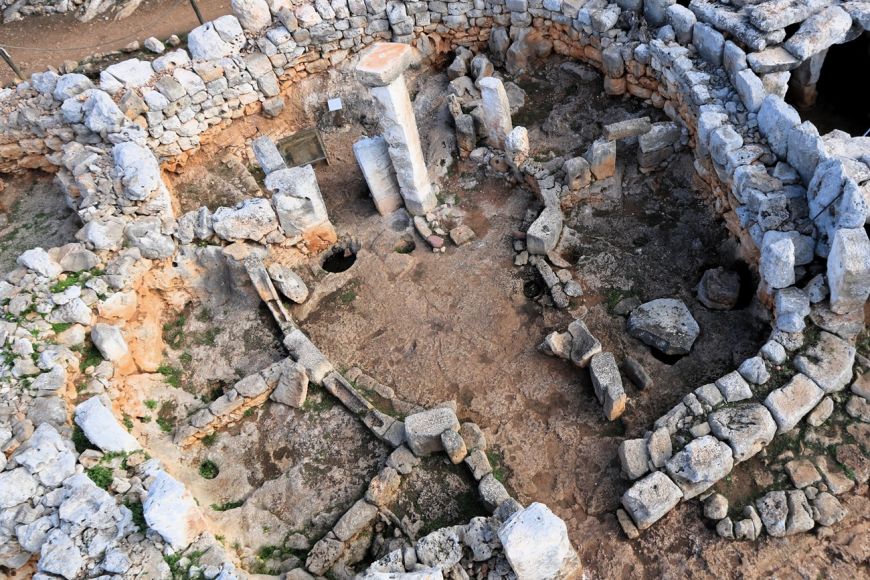
Scattered along the slopes are numerous circular houses, some of which have been excavated and partially restored:
Perimeter walls built from large stones define the outline of each dwelling.
The interior was divided into rooms by radial walls.
A central patio, open to the sky, contained the hearth and a cistern for collecting rainwater.
Walking among these houses, you can picture how daily life was organised: spaces for cooking, sleeping, storing tools and sheltering animals.
4. Hypostyle rooms and the water system
Sa Torre d’en Gaumés also features other fascinating structures:
Hypostyle rooms: semi-subterranean spaces with stone columns supporting large roof slabs. They are thought to have been used as storage areas, workspaces or animal shelters.
Water-collection system: a complex network of channels and underground cisterns that captured rainwater and made use of the hill’s natural slopes.
These solutions show the Talayotic community’s deep understanding of the environment and resource management.